Prices for all 8 Mac Studio M5 configurations (VAT included)
Mac Studio M5 Max starts at 79,800,000₫, M5 Ultra at 182,400,000₫. Each card shows the AI model size it can run — filter by chip, RAM or the model size you need.
Compare configurationsCompare the Mac Studio chips side by side, or tick “Compare” on any card (up to 4 machines, Mac Studio and Mac mini can be mixed).
Prices include VAT. SSD upgrades cost extra — choose them on each machine's detail page. Specifications as published by Apple, updated September 24, 2026.
Compare 8 configurations at a glance: RAM, bandwidth and model size
| Configuration | CPU / GPU | Memory | Bandwidth | Max model | Price |
|---|---|---|---|---|---|
| M5 Max 18/32 · 36GB | 18 / 32 cores | 36GB | 460GB/s | ~43B | 79,800,000₫ |
| M5 Max 18/40 · 48GB | 18 / 40 cores | 48GB | 614GB/s | ~57B | 98,610,000₫ |
| M5 Max 18/40 · 64GB | 18 / 40 cores | 64GB | 614GB/s | ~76B | 111,150,000₫ |
| M5 Max 18/40 · 128GB | 18 / 40 cores | 128GB | 614GB/s | ~153B | 161,310,000₫ |
| M5 Ultra 30/64 · 96GB | 30 / 64 cores | 96GB | 1.2TB/s | ~115B | 182,400,000₫ |
| M5 Ultra 30/64 · 256GB | 30 / 64 cores | 256GB | 1.2TB/s | ~307B | 307,800,000₫ |
| M5 Ultra 36/80 · 96GB | 36 / 80 cores | 96GB | 1.2TB/s | ~115B | 223,160,000₫ |
| M5 Ultra 36/80 · 256GB | 36 / 80 cores | 256GB | 1.2TB/s | ~307B | 348,560,000₫ |
Memory bandwidth determines how fast the machine generates text. GPU core count determines how quickly it processes a long prompt before it starts answering.
How much RAM do you need for each model size?
How much RAM you need to run an LLM locally depends on the model size: from ~43B parameters on the 36GB version to ~307B on the 256GB version. For language models, memory capacity decides whether a model fits at all, and memory bandwidth decides how fast it runs. The table below converts machine memory into the model size it can run.
| System memory | Available to the model | Max model size (4-bit) | Best for |
|---|---|---|---|
| 36GB | ~27GB | ~43B | Assistant for Q&A over internal documents, summarizing and drafting for a small team |
| 48GB | ~36GB | ~57B | As above, with headroom for longer context and more people asking at once |
| 64GB | ~48GB | ~76B | Mid-size models, running several tasks in parallel |
| 96GB | ~72GB | ~115B | Large models, long documents, serving many concurrent users |
| 128GB | ~96GB | ~153B | Large models at lighter quantization, for higher-quality answers |
| 256GB | ~192GB | ~307B | Very large models, or several models at once on one machine |
These are estimates to help you choose a machine, not benchmark results. The method: a 4-bit quantized model takes about 0.5 bytes per parameter; macOS lets the GPU use about 75% of memory; a further 20% is reserved for conversation context. Real-world figures vary with the model, context length and number of concurrent users — Namtech will test on real hardware for you before you commit to a configuration.
Mac Studio M5 Max or M5 Ultra: which should you choose?
Choose M5 Max when the model you need to run is under about 153B parameters and you have a moderate number of users. Choose M5 Ultra when you need larger models, longer context or many people querying at once — Ultra has roughly double the memory bandwidth and GPU cores.
| M5 Max | M5 Ultra | |
|---|---|---|
| CPU / GPU | 18 / 32/40 cores | 30/36 / 64/80 cores |
| Neural Engine | 16 cores | 32 cores |
| Unified memory | 36–128GB | 96–256GB |
| Memory bandwidth | 460GB/s/614GB/s | 1.2TB/s |
| Max model (estimate, 4-bit) | ~153B | ~307B |
| Price (VAT included) | 79,800,000₫ – 161,310,000₫ | 182,400,000₫ – 348,560,000₫ |
Bandwidth determines how fast text is generated; GPU core count determines how quickly a long prompt is processed. Chip, RAM and bandwidth figures as published by Apple, checked September 24, 2026.
Mac Studio vs an RTX 5090 PC, NVIDIA DGX Spark and AI servers
No single machine is best for every workload. The key differences are how much memory a single machine has for the model, where the machine sits, and the software ecosystem. The table below is a qualitative comparison, not a speed benchmark.
| Option | Memory for the model | Strengths | Considerations |
|---|---|---|---|
| Mac Studio M5 Max / M5 Ultra | 36–256GB unified memory | Loads models up to ~307B on one machine; 480W maximum continuous power rating; sits on a desk | Slower than dedicated GPU systems at processing very long context |
| RTX 5090 discrete-GPU PC | 32GB of graphics memory per card (NVIDIA) | Suits models that fit in 32GB; many AI tools are written for NVIDIA first | Larger models need multiple cards, which draw more power and need more cooling |
| NVIDIA DGX Spark | 128GB unified memory (NVIDIA) | Compact desktop that runs the NVIDIA software ecosystem | Less memory than the 256GB option on Mac Studio M5 Ultra |
| Multi-GPU AI server | Depends on the number of cards installed | Strongest when many people query at once with very long context | Needs a server room, rack and dedicated cooling; high capital and power costs |
RTX 5090 and DGX Spark memory figures are taken from NVIDIA’s official product pages, checked on September 24, 2026.
What to consider before you decide
Mac Studio is strong at generating text thanks to its high memory bandwidth, but for reading and understanding very large amounts of text (for example, feeding an entire set of files into every question), dedicated GPU systems are still faster. If your workload leans toward many people asking at once with very long context, let us know and we will test it before you buy.
When Mac mini is enough, and when you need Mac Studio
Mac mini is enough when
You are just trying out local AI, running small models, have only a few users, or mainly summarize and draft short documents.
Move up to Mac Studio when
You need large models, long context, many people asking at once, or several models on one machine. Mac Studio offers 36–256GB of memory.
The lowest-priced Mac mini configuration is the Mac mini M6 12CPU 12GPU 16GB 256GB at 28,500,000₫, which runs models up to ~19B. Mac mini offers 16–64GB of memory.
Our advice is straightforward: if a Mac mini is enough for your workload, Namtech will tell you before you spend money on a Mac Studio.
On-premise AI deployment: your data stays in the office
On-premise AI means the model runs on a machine located at your company. Questions, documents and answers all stay on your internal network — the foundation for an internal chatbot, a Q&A assistant over your document library, file summarization and drafting.
Unified memory
The CPU and GPU share one pool of memory. No need to split a model across multiple graphics cards, and no overhead syncing between cards.
Fits in an office
9.5 cm tall, 2.7–3.6 kg, runs quietly. No server room, no rack, no dedicated cooling system required.
Low power draw
Maximum continuous power rating of 480W for the whole machine; per Apple, measured maximum consumption is about 200W (M5 Max 18/32) to 385W (M5 Ultra 36/80). A multi-GPU system with comparable memory typically draws several times more, adding to power and cooling costs.
Your data stays in-house
The model runs locally and makes no calls to outside services. Suitable for HR records, contracts, customer data and internal documents.
Genuine machines and accessories are sold and VAT-invoiced by Decorp; Namtech advises on the configuration and can install and tune the software that runs your models (MLX, Ollama or LM Studio) to your requirements (quoted separately).
Specifications common to all configurations
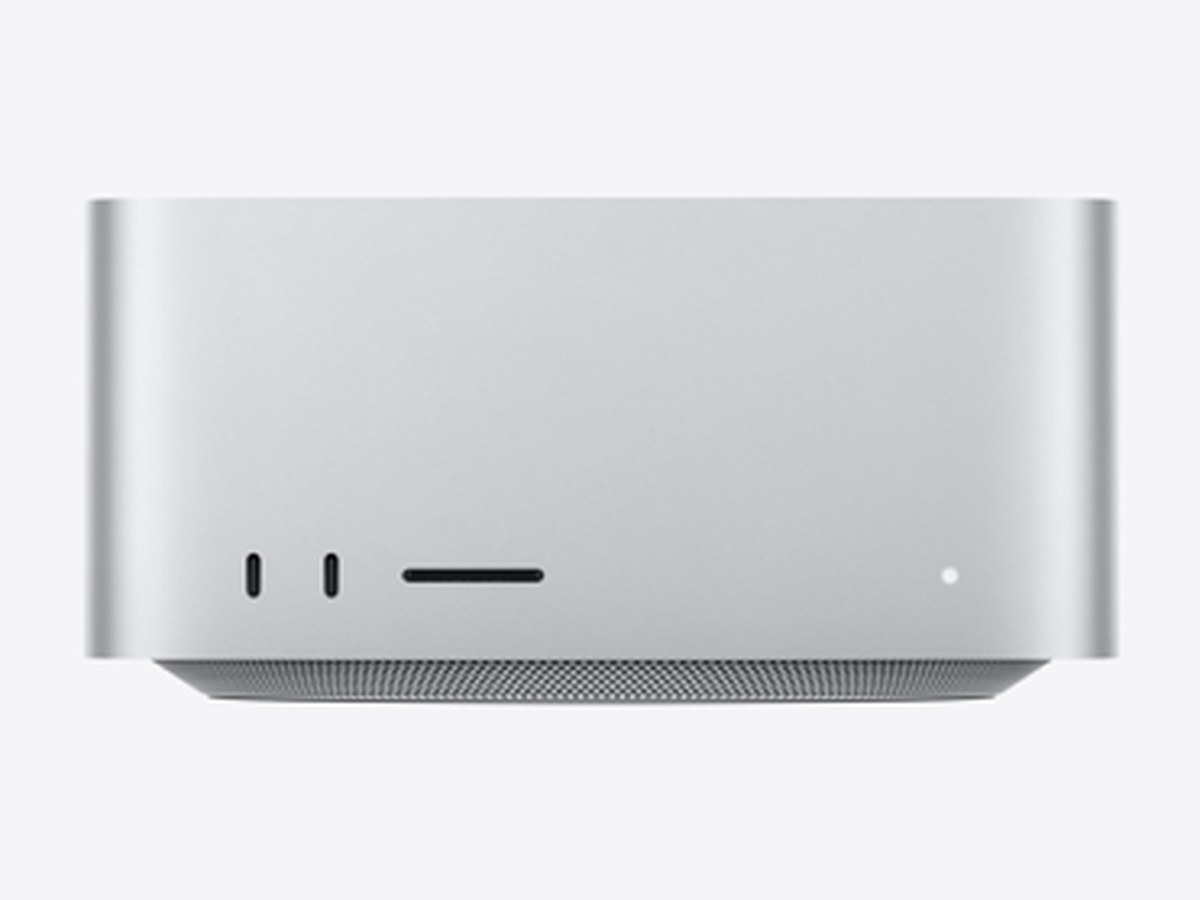
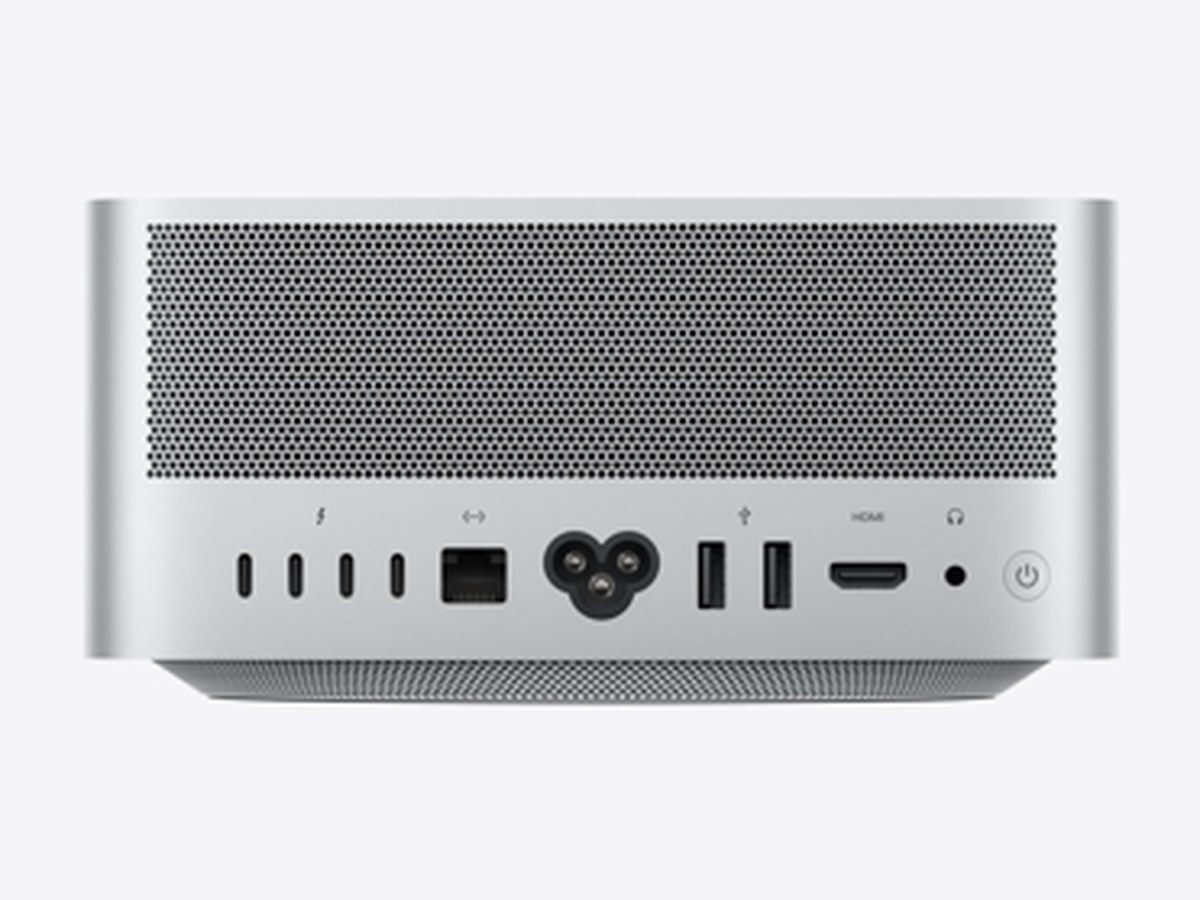
| Ports | 4× Thunderbolt 5 (USB-C, up to 120Gb/s, DisplayPort 2.1) · 2× USB-A (up to 5Gb/s) · 1× HDMI 2.1 · 1× 10Gb Ethernet (Nbase-T, RJ-45) · 3.5 mm headphone jack · Front: SDXC card slot (UHS-II) + 2× USB-C 10Gb/s (M5 Max) or 2× Thunderbolt 5 (M5 Ultra) · Wi-Fi 7 (802.11be), Bluetooth 6, Thread — Apple N1 chip |
|---|---|
| Display support | M5 Max: up to 5 external displays · M5 Ultra: up to 8 external displays (6K@60Hz) |
| Dimensions | Height 9.5 cm · Width 19.7 cm · Depth 19.7 cm |
| Weight | 2.7 kg (M5 Max) · 3.6 kg (M5 Ultra) |
| Power | 100–240V AC, maximum continuous power 480W · operating temperature 10–35°C |
| In the box | Mac Studio and power cord. Display, keyboard and mouse sold separately. |
Source: Apple’s official technical specifications, checked on September 24, 2026.
Mac Studio for local AI: frequently asked questions
What hardware do you need to run AI locally?
The most important factor is enough memory to hold the model, followed by memory bandwidth. Rule of thumb: a 4-bit quantized model takes about 0.5GB per billion parameters, plus extra for conversation context. The lowest-priced Mac Studio on this page (36GB, 79,800,000₫) runs models up to about 43B parameters; the 256GB version runs up to about 307B.
How much RAM do you need to run an LLM locally?
It depends on the model size: 36GB runs up to ~43B, 64GB up to ~76B, 96GB up to ~115B, 128GB up to ~153B and 256GB up to ~307B parameters (estimates at 4-bit quantization). The method: macOS lets the GPU use about 75% of memory, 20% is reserved for context, and each parameter takes about 0.5 bytes.
Can Mac Studio run a 70B model?
Yes, on the 64GB version and above. The lowest-priced configuration that runs a 70B model is the Mac Studio M5 Max 18CPU 40GPU 64GB 512GB at 111,150,000₫ (VAT included), which holds models up to about 76B at 4-bit quantization. To run 70B at lighter quantization for higher-quality answers, or to serve many people at once, choose 128GB or more.
What hardware do you need to run DeepSeek locally?
It depends on which version of DeepSeek you plan to run. The smaller distilled versions, with a few tens of billions of parameters, run on the 36GB version and above (~43B). The full DeepSeek model is far larger than the ~307B that a 256GB machine can hold at 4-bit, so it needs heavier quantization or several machines linked together. Send us the specific model name and Namtech will map it to a suitable configuration.
How much do Mac Studio M5 Max and M5 Ultra cost?
Mac Studio M5 Max is priced from 79,800,000₫ to 161,310,000₫, and M5 Ultra from 182,400,000₫ to 348,560,000₫ with default storage. Prices include VAT; the machines are sold and VAT-invoiced by Decorp, and Namtech advises on choosing a configuration for the AI models you need to run. SSD upgrades cost extra — choose them on each machine's detail page.
What is the difference between Mac Studio M5 Max and M5 Ultra?
M5 Ultra offers roughly twice what M5 Max does where it matters for AI: memory bandwidth of 1.2TB/s vs 460GB/s or 614GB/s, a 64- or 80-core vs 32- or 40-core GPU, and a 32-core vs 16-core Neural Engine. M5 Max has 36–128GB of memory (models up to ~153B); M5 Ultra has 96–256GB (up to ~307B).
What models can Mac Studio 96GB and 256GB run?
The 96GB version runs models up to about 115B parameters, the 256GB version up to about 307B (estimates, 4-bit quantization). The 96GB version suits large models for many concurrent users; the 256GB version suits very large models or running several models at once. Prices: 96GB version 182,400,000₫ – 223,160,000₫; 256GB version 307,800,000₫ – 348,560,000₫, VAT included.
Mac Studio or an RTX 5090 PC: which is better for AI?
It depends on the model size. According to NVIDIA, the RTX 5090 has 32GB of graphics memory, so models larger than that need multiple cards or run more slowly. Mac Studio uses up to 256GB of unified memory, loads models up to ~307B on one machine, with a maximum continuous power rating of 480W (per Apple, measured maximum consumption is about 200W–385W depending on configuration). Conversely, for models that fit in 32GB and tools written specifically for NVIDIA, an RTX 5090 PC is worth considering.
How does Mac Studio compare with NVIDIA DGX Spark?
Both are desktop machines with unified memory. According to NVIDIA, DGX Spark has 128GB of unified memory; Mac Studio M5 Ultra offers a 256GB option, holding larger models on one machine. DGX Spark has the advantage of running NVIDIA's software ecosystem. Mac Studio runs macOS, sits neatly in an office and can be used as an ordinary work computer.
Can a Mac mini run local AI?
Yes, for small models, experiments or a few users. When you need large models, long context or many people asking at once, move up to Mac Studio, which offers 36GB to 256GB of memory. Namtech gives straightforward advice: if a Mac mini is enough for your workload, we will tell you.
What is on-premise AI, and how is it different from cloud AI?
On-premise AI is an AI model running on a machine located at your company, with no questions or documents sent to outside services. Cloud AI is the opposite: data passes through the provider's servers and is usually billed per use. On-premise suits HR records, contracts and customer data; the trade-off is a one-time hardware investment that your business manages itself.
Can Mac Studio run an internal chatbot?
Yes. Mac Studio can run a Q&A assistant over your internal document library for staff on the company network, with no data leaving. The machine itself is standard, unmodified Apple hardware; Namtech can install and tune the software that runs your models (MLX, Ollama or LM Studio) to your requirements, quoted separately based on the scope of work.
Can I upgrade the RAM after purchase?
No. Mac Studio memory is built into the chip, so you must choose the right amount when you order. That is why you should work out the size of the models you plan to run before settling on a configuration.
Is a VAT invoice issued?
Yes. Prices listed on this page include VAT. Machines and accessories are sold by Decorp, which issues full VAT invoices to businesses; Namtech advises on the configuration and installs the AI software. Configurations with upgraded RAM or SSD are built to order; we confirm the delivery date when we receive your request.